Deep dive May 14, 2026 · 4 min read
WebAssembly in 5 minutes — how browser tools got desktop-fast
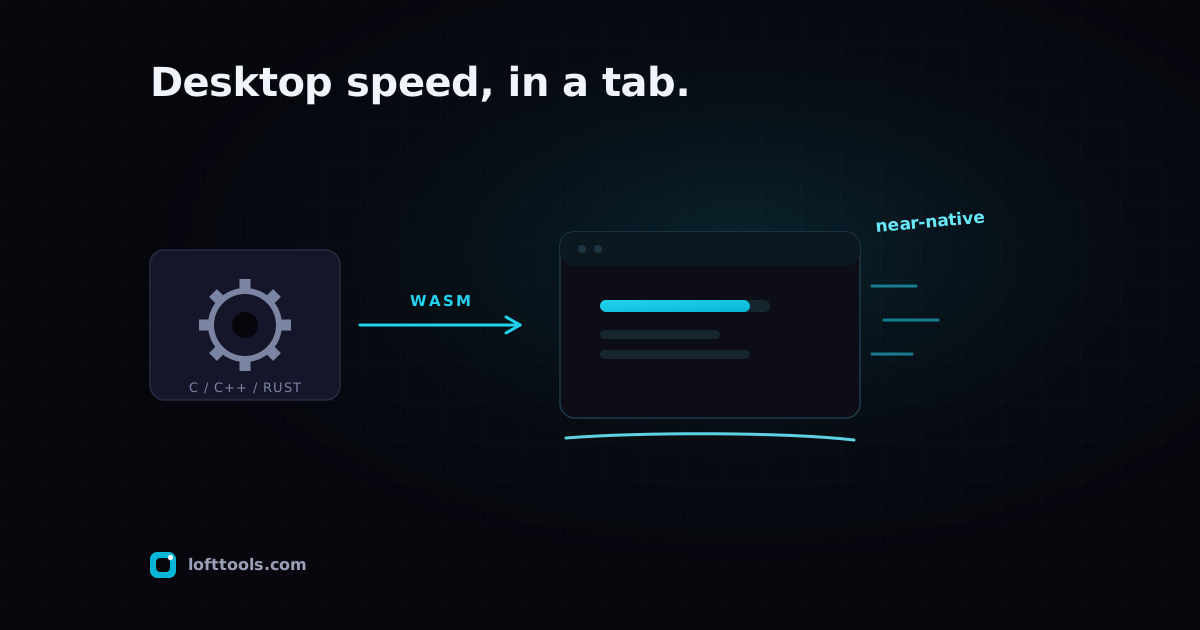
WebAssembly is the technology that lets a browser tab run code at speeds comparable to a native desktop app. It is why browser-side PDF, image, and video tools work as well as they do in 2026. Here is the five-minute version, with no JavaScript required to follow.
By Khine 778 words Extractable lead
§1 — Problem statement
For most of the web’s history, the only language that ran in the
browser was JavaScript. JavaScript is well suited for forms,
interactions, animation — anything close to the page. It is
substantially slower than compiled C, C++, or Rust for numerical
work — image filters, PDF rendering, video encoding, ML
inference. The performance gap meant heavy workloads ran either
server-side (upload, process, download) or in a native app
(install a desktop binary).
WebAssembly closes the gap.
§2 — Definition
A WebAssembly module is a compact binary file with a .wasm
extension. Inside is machine-portable bytecode — instructions
like “add these two numbers,” “load this memory address,” “call
this function.” It is not JavaScript and not English; it is an
intermediate language browsers know how to execute very quickly.
The browser fetches a .wasm file the same way it fetches a
JavaScript file: download, parse, run. The difference is that
the parsing step is faster (WASM is smaller and more predictable
than JS) and the running step is faster too (WASM’s bytecode
maps cleanly onto modern CPU instructions).
§3 — Loft’s WASM usage
Three of Loft’s heaviest workloads run as WASM.
§3.1 — PDFium (WebAssembly)
Google’s PDF engine (PDFium) — the same engine Chrome uses
internally to render PDFs. Compiled to WASM and packaged for
the browser. Handles PDF rendering and most of the read paths.
§3.2 — FFmpeg (WebAssembly)
Industry-standard tool for video and audio encoding. Compiled
to WASM. Handles every video tool — compress, trim, convert,
extract audio.
§3.3 — ONNX Runtime Web
Microsoft’s runtime for ONNX-format machine-learning models.
Compiled to WASM with WebGPU acceleration where supported.
Runs PaddleOCR for OCR and MODNet for portrait matting.
All three are mature C/C++ projects that pre-date the web tools
built on them. Compiling to WASM means we get their full
feature set in the browser without anyone re-writing twenty
years of work.
§4 — Why this changes the privacy story
Before WASM, browser-side PDF processing was genuinely too slow
for production use. JavaScript took twenty seconds to compress a
single page; the heap melted on anything bigger than a small
PDF. So tools uploaded to a server because that’s where the C++
libraries lived.
WASM put those libraries in the browser tab. The privacy upgrade
is a side effect of an engineering breakthrough. The file does
not need to leave because the code that can read it is already
on your machine.
§5 — Constraints
| Constraint | Detail |
|---|
| Memory ceiling per tab | a per-tab memory cap, low hundreds of MB on modern phones, higher on desktop |
| First-load weight | several MB compressed for PDFium, ~30 MB for FFmpeg |
| Native vs WASM speed | WASM is comparable, not equal; ~1.5-2x slower than native binary for the same workload |
| Browser support | every modern browser supports WASM, has for years |
| WebGPU acceleration | Chrome 113+, Edge 113+, Safari 18+ |
| Security model | runs in the same browser sandbox as JavaScript — strong, but not magically safer |
§6 — Verification
To see WASM in action in your browser: DevTools → Network →
filter on .wasm. Open any Loft PDF tool. You’ll see the
.wasm modules loading at first paint. After that, cached.
You can also see WASM execution via DevTools → Performance.
Record a tool run; the WASM call frames show up in the flame
graph distinct from JavaScript frames.
§7 — Open questions
A few things still aren’t settled in the WASM ecosystem and
will likely change over the next few years:
- Multi-threading via SharedArrayBuffer. Available on
cross-origin-isolated pages (Loft tools pages meet this requirement).
Some workloads benefit greatly, some don’t yet. We use it for
FFmpeg-MT and ORT.
- WebGPU adoption. ORT’s WebGPU path is now stable on
Chrome/Edge; Safari 18 added it. The performance lift over
WASM-only is large (often 5-10x) for neural-network
inference.
- GC-managed languages. New WASM features (
reftype,
gc, stringref) let languages like Java and Kotlin
target WASM without bringing their own GC. Not yet relevant
for Loft’s stack, but the language landscape is widening.
§8 — References
I had to look up the exact byte format for §2 twice before
that paragraph survived a self-review. The “machine-portable
bytecode” framing is correct but easy to wave at; the
WebAssembly binary encoding spec
has the full version if you want it.