Investigation May 26, 2026 · 5 min read
Smallpdf, PDF24, iLovePDF — what their privacy policies actually let them do
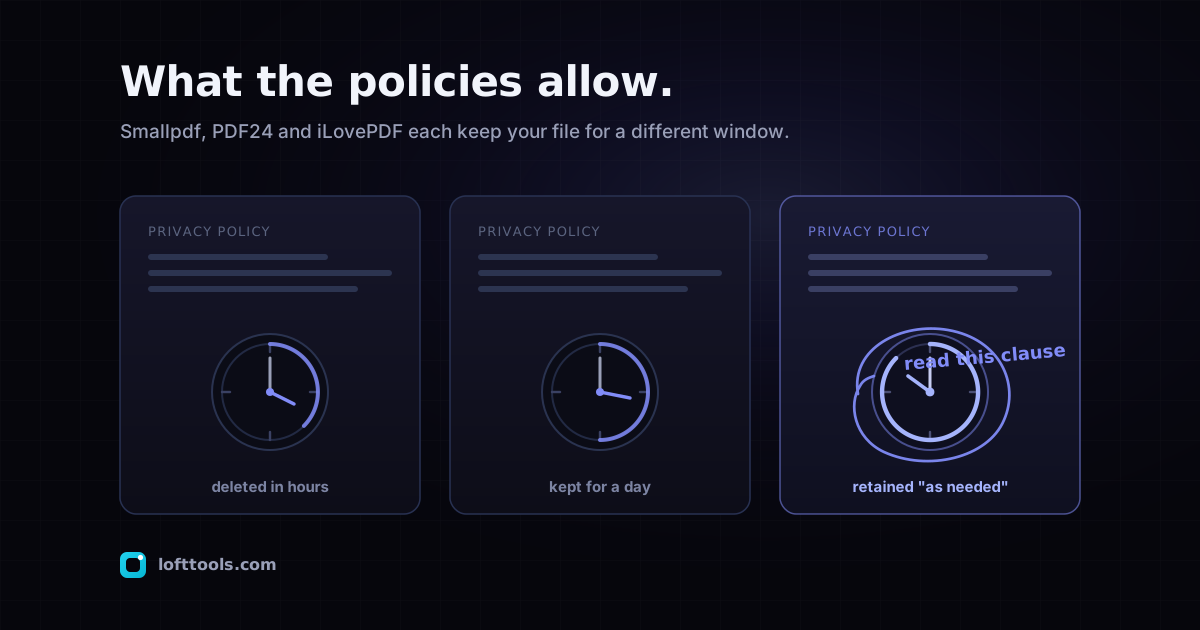
Three of the most-used online PDF tools — Smallpdf, PDF24, iLovePDF — all publish reasonable privacy policies. The policies are also broader than the marketing suggests. Here is what each one allows on paper, with quoted wording where available.
By Khine 941 words Extractable lead
This document compares the published privacy positions of three
of the most-used online PDF tools — Smallpdf, PDF24, and
iLovePDF. The goal isn’t to argue any of them is acting in bad
faith; all three are responsible operators on the AEC scale.
The goal is to show what each one’s policy permits on paper,
which is broader than the marketing copy suggests, and what the
local-first alternative removes from that surface area.
Sources for each retention claim are cited inline. Access dates
are in the citations block at the bottom of the post.
Smallpdf
Stated retention. Anonymous files processed by free tools
are deleted within one hour. Files routed through eSign or shared
via file-sharing are kept up to 14 days. Pro users with active
File Storage can retain files indefinitely until manually
deleted. Source: the
HonestPDF Smallpdf review
summarising Smallpdf’s published policy.
Infrastructure. Hosted on Google Cloud Platform, primarily
in Europe.
What the policy permits beyond the obvious.
- Aggregation of usage statistics across users, with file
metadata retained beyond the file itself.
- Sharing data with sub-processors (cloud providers, payment
processors, analytics vendors). The policy lists them.
- Account data retention indefinite while account is active,
plus the standard accounting / legal-retention overlay after
deletion.
- Marketing communications to account holders unless opted out.
Surface area observation. Responsible operator, conservative
retention for the routine file-processing use case, normal
account-data retention for Pro tier. The “file deleted in one
hour” claim applies to the file content; metadata about the
operation persists longer.
PDF24
Stated retention. One-hour deletion window for processed
files, with the option to manually delete sooner if logged in.
Source:
HonestPDF PDF24 review.
Infrastructure. PDF24’s online tools run on infrastructure
operated by Geek Software GmbH (the company behind PDF24).
What the policy permits beyond the obvious.
- Use of essential and analytics cookies (cookie banner
present).
- Standard sub-processor relationships (hosting, analytics).
- A free desktop tool (“PDF24 Creator”) that processes locally
— interesting because it suggests PDF24 themselves know
local-first is the privacy story; they just don’t apply it
to the online tools.
Surface area observation. Probably the most privacy-pragmatic
of the three. Short retention window, no aggressive
cross-context tracking, local desktop tool for users who want
it. Still uploads the file during the online flow.
iLovePDF
Stated retention. 1, 2, or 24 hours depending on account
tier. Source:
iLovePDF Privacy and
HonestPDF iLovePDF review.
Infrastructure. Cloud (specific provider not stated on the
public page; ISO 27001 certified for the operations).
What the policy permits beyond the obvious.
- Cross-product feature integration — sharing data between
iLovePDF web, mobile, and desktop products for the same
user.
- Marketing communications subject to opt-out.
- Use of sub-processors listed in the policy.
- For team / business plans, additional admin-side access to
member-uploaded files within the team workspace.
Surface area observation. Similar to Smallpdf — responsible
operator, short retention by default, broader allowances for
paid tiers. The ISO 27001 cert means an external auditor has
reviewed the controls; that’s a meaningful signal.
Side-by-side surface area
| Surface | Smallpdf | PDF24 | iLovePDF | Loft |
|---|
| File uploaded to server | yes | yes | yes | no |
| File deleted after window | 1 hr / 14 d / ∞ | 1 hr | 1 / 2 / 24 hr | n/a |
| Metadata retained longer | yes | yes | yes | URL path, country, and timestamp — never file content |
| Account required for full features | yes | no | yes | no |
| Marketing email opt-in default | yes | no | yes | no |
| Sub-processors involved | several | a few | several | Cloudflare, Stripe, Microsoft (email) — see our privacy policy §5 |
| File subject to operator-side breach risk | yes | yes | yes | no |
The “no” cells reflect architecture, not virtue. The local-first
architecture removes the opportunity for each surface; the
operator can’t lose what they don’t have.
What Loft accepts in trade
The local-first architecture doesn’t get team-workspace features
(because no accounts), batch processing in the cloud (because no
cloud), shared real-time review (because no server). Many
power-user workflows that depend on shared state across users
are out of scope for us. The three operators above all ship
those features and have honest reasons to do so.
For routine, single-document, occasional use — the bulk of what
“online PDF tools” get used for — the local-first model has a
strictly smaller privacy surface. For deep enterprise workflows
across teams, the cloud-side operators are often the right
tool.
Notes on methodology
We tried not to cherry-pick. All three operators in this post
are major brands with millions of users and published policies.
The retention windows are quoted (via HonestPDF’s summaries of
the published policies) rather than inferred. We deliberately
omitted weaker operators whose policies would make the
comparison look more dramatic.
One thing I keep tripping over while writing this kind of
comparison: the operators’ policies are written in
legal-document register, and translating them into “what this
permits” requires interpretation. Where I’m quoting a fact
(retention windows, certifications, infrastructure provider),
I cite. Where I’m interpreting what a clause permits, I say
“the policy permits” rather than “the operator does.” If
you’re using this post as input to a serious privacy decision,
read each operator’s actual policy text alongside it.
Update policy
This document is updated when any of the three operators
publishes a significant policy change. Last reviewed
2026-05-27. The retention windows are accurate as of access
dates in the citations.